Last week, the Dodgers signed Kyle Tucker to a 4-year, $240M contract - adding him to their already back-to-back winning lineup, and keeping him away from the Mets and Blue Jays, two of their biggest three-peat threats.
Around the same time, I read an article talking about how the WNBA was set to miss a negotiating deadline between the league and the players’ association - with the two parties at a bit of an impasse over how to share revenue over their next collective bargaining agreement (CBA).
The juxtaposition between the two sports was almost comical - on one hand, we have Tucker making an unprecedented $60M per year - and on the other, we have WNBA teams with salary caps of $1.5M for their entire rosters, with the average player making $120k.
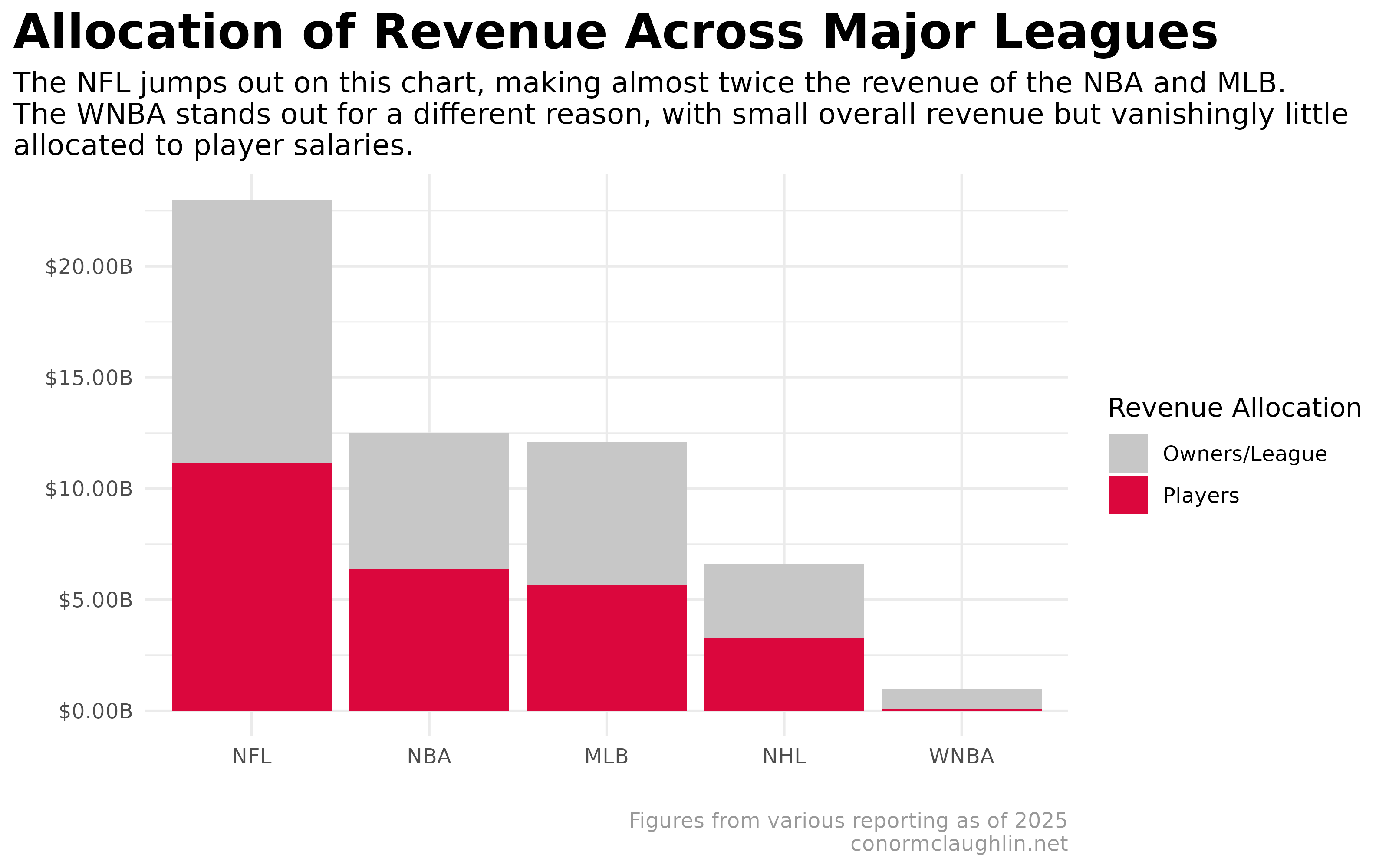
To be sure, MLB makes a lot more money than the WNBA. Looking at best estimates for sport-related income in 2025 pegs the MLB at roughly $12B in revenue, with the WNBA at roughly $1B. However, there is a massive disparity in how much of that revenue allocated to the players -> the WNBA’s payout to the players is proportionately tiny.
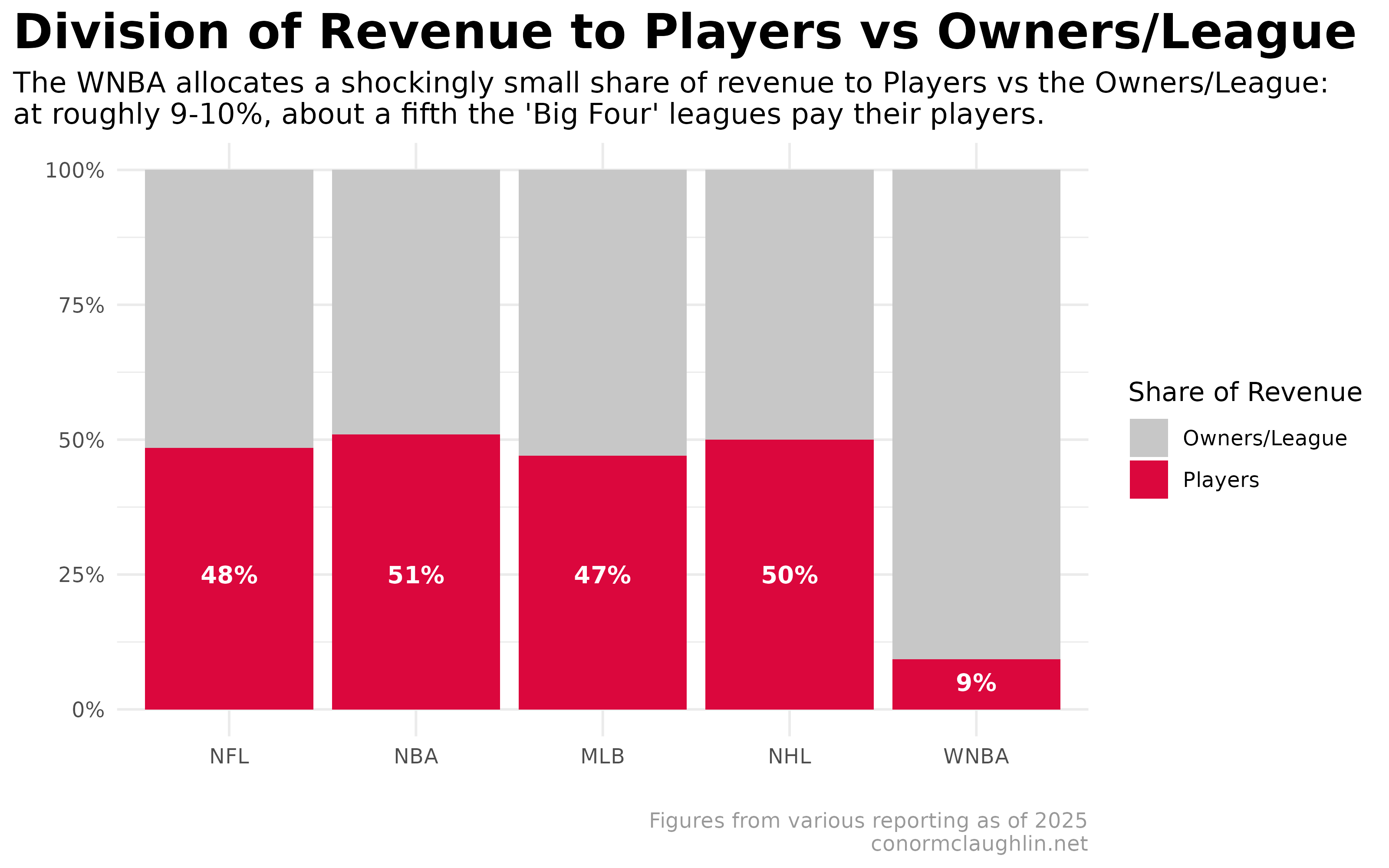
When presented as a share of total revenue, the magnitude of just how different the WNBA is from the “Big Four” American sports leagues really pops. Relative to the fifty/fifty split that NBA players currently have with the league and owners, WNBA players currently take a mere 10 percent of revenue - a fifth of what their male colleagues earn.
I’m far from the first person to write about this topic, but with negotiations between the league and players continuing to be stalled, I’m hoping that every bit of pressure on the league can help drive a resolution that avoids a lockout and gives the players a meaningful increase in their slice of the league’s revenue… revenue that has been on the upswing in large part because of players like A’ja Wilson, Breanna Stewart, and Caitlyn Clark. Pay them more!